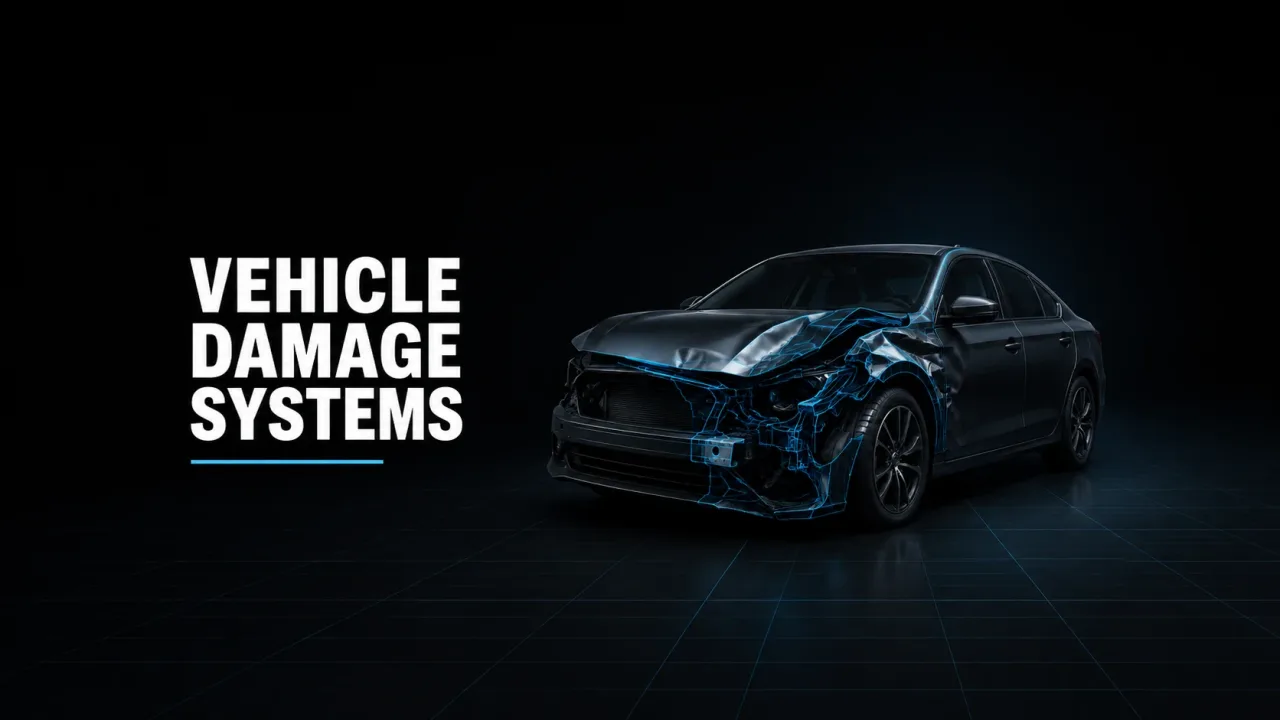
Vanilla GTA V is absurdly forgiving about crashes. Fold a Sultan around a lamppost at 90mph, reverse out, and half the damage quietly walks itself back the next time you get in. That's the default your roleplay city inherits, and it's why FiveM vehicle damage is one of the highest-leverage systems on the whole server: it decides whether a pursuit feels tense or feels like bumper cars, and whether your mechanic job has customers or just a nice building.
Getting it right isn't "install a realism script and crank the multipliers". Damage in this engine is three separate systems that get conflated constantly, and each one breaks in a different way.
What FiveM vehicle damage actually means in GTA V
GTA V splits vehicle damage into three layers: visual deformation (panels crumpling, governed by handling.meta), mechanical health pools (engine, body and petrol tank, each on a 0–1000 scale), and handling degradation (torque and steering penalties). The base game barely implements the third. Damage scripts almost entirely exist to add it.
The important consequence: deformation is cosmetic. A car can look like a folded crisp packet and still drive perfectly, and a showroom-clean car can be sputtering on 150 engine health. Deformation is a physics-mesh state each client renders; the numbers your scripts can read, sync and persist are the health values. Tell your staff team that once and you'll close a lot of "my car is broken but it looks fine" tickets.
Petrol tank health matters more than people expect. It also runs to 1000 and starts leaking fuel around 650, which is the mechanic behind "why did my car catch fire twenty seconds after the crash?" The fire wasn't the impact. It was the puddle.
The handling.meta fields that decide how hard a car breaks
Damage behaviour is per-vehicle, baked into each car's handling line. If you've already tuned grip and top speed on your fleet, these are the fields sitting a few lines below the ones you touched:
| Field | Range | What it does |
|---|---|---|
| fDeformationDamageMult | 0.0–10.0 | Visual crumple only. 0.0 = panels never bend, 2.0 = double the bodywork damage per impact |
| fCollisionDamageMult | 0.0–10.0 | Mechanical damage from impacts. Setting this to 0.0 also kills engine damage |
| fEngineDamageMult | 0.0–10.0 | Engine wear leading to failure and fire; responds most to bonnet-area hits |
| fWeaponDamageMult | 0.0–10.0 | Gunfire and explosive resistance — your pursuit and gang-RP lever |
| fPetrolTankVolume | ~40–100 | How much fuel leaks after the tank is punctured |
| fOilVolume | ~5–10 | Roughly how long a dying engine smokes before it quits |
| fMonetaryValue | vehicle-specific | Base value — useful as a repair-pricing input, covered below |
| strDamageFlags | hex | Marks panels unbreakable: 0x10 bonnet, 0x20 boot, 0x1–0x8 the four doors |
Then the model flags, which are where imported packs cause chaos. 0x4000000 (MF_INDESTRUCTIBLE) makes a vehicle immune to everything. 0x2000000 (MF_NO_WHEEL_BURST) blocks tyre pops, 0x40000000 (MF_NO_WHEEL_BREAK) stops wheels detaching, and 0x40000 (HF_REDUCED_DRIVE_OVER_DAMAGE) cuts damage taken from hitting pedestrians.
Grep those flags across your stream folders before blaming your damage script. "The damage system works on everything except our supercars" is nearly always a pack that shipped MF_INDESTRUCTIBLE, or a fCollisionDamageMult of 0.0 so the showcase footage looked clean. Reputable vehicle packs on cfxcars-tebex.io ship sane per-car damage values, but audit anything you buy on arrival — five minutes, and it saves an evening of misdiagnosis.
Health pools and the auto-repair trap
This is the one that catches everybody. GTA V quietly restores vehicle health under several conditions — re-entering, respawning, streaming back in — and SetVehicleAutoRepairDisabled has a long history of not fully doing what its name promises. So cars heal themselves, and the damage script takes the blame.
The only durable fix is server-authoritative persistence. When a car goes into a garage, write engine, body, fuel and tank health to the owned-vehicle row alongside the mods blob you're already saving. When it spawns, restore them. Do the same on player disconnect for anything left out in the world you intend to keep.
One gotcha while you build it: GetVehicleEngineHealth and GetVehicleBodyHealth are known to disagree between client and server. Treat the owning client as the reading source, send it up with the store event, and clamp server-side to sane bounds so a modded client can't write 1000 into a wreck.
What damage-realism scripts actually add
Nearly every "realistic vehicle failure" resource descends from the same open-source lineage, so these config keys are worth knowing whichever one you bought. The defaults, and my honest read on them:
damageFactorEngine = 2.0,damageFactorBody = 3.0— reasonable starting points for serious RP.damageFactorPetrolTank = 64.0— punishing. A moderate tap starts a fuel leak. Drop it to single digits unless you want cars burning out weekly.degradingFailureThreshold = 800.0andcascadingFailureThreshold = 360.0— the two numbers that define your damage curve: gentle degradation below 800, rapid collapse below 360.engineSafeGuard = 100.0— the floor the engine stops at. Set this to0.0and cars die outright; keep it above zero and they limp.limpModewithlimpModeMultiplier = 0.19— a dying car crawls instead of stopping dead. Enable it.torqueMultiplierEnabled = true— power drops as the engine wears. This is the single setting that makes damage felt rather than just displayed.compatibilityMode— stops the resource touching petrol tank health. Turn it on if you run LegacyFuel, ox_fuel or similar, or your fuel script and your damage script will fight over the same value all night.
On top of that layer sit the extras: wheel-loss scripts that detach a wheel on a hard enough hit, engine stalling on impact, and injury triggers. They're separate resources for a reason — stack them one at a time and test between each.
Where to draw the line between simulation and playable
My rule: damage should cost time and money, never a session. That resolves most of the arguments.
Full-sim settings feel incredible for about a week. Then someone gets tapped by an NPC at 3am, the engine dies 4km from any garage with no tow driver online, and they alt-F4 into a different city. Arcade immunity fails from the other end — a crash that costs nothing means nobody drives carefully, pursuits become demolition derby, and your mechanic economy is dead on arrival.
The playable middle is specific: cars degrade noticeably, limp rather than die, and can always be made drivable again by someone — a roadside kit, a mechanic, or a tow. If a player can get stranded with zero options, your config is wrong no matter how realistic it feels.
Damage as an economy: repairs, parts and tow RP
Damage is the best money sink in the game, because unlike a shop purchase it's involuntary. Price it off the vehicle rather than flat, and it self-balances: a full mechanic repair at roughly 8–12% of the car's sticker means a beater costs pocket change and a supercar hurts appropriately. fMonetaryValue or your dealership price both work as the input.
A three-tier ladder covers almost every situation:
- Roadside repair kit (inventory item, consumable) — restores engine to around 600 and gets you moving. Doesn't fix the body, doesn't fix the visuals. Cheap.
- Mechanic full repair (job-gated) — everything back to 1000, priced as a percentage of value, with the mechanic taking a cut.
- Tow and recovery — for cars that can't move. Pay tow drivers on distance plus vehicle value so hauling a wrecked supercar off the freeway is worth the drive.
Servers skip that third tier constantly, and it's the one that turns a punishing config into roleplay instead of a rage-quit. It also fixes an operational problem: abandoned wrecks across the map are entities your server pays to sync. Give someone a financial reason to remove them.
The mechanic-job and repair-item resources on buy-tebex.io hook the same health natives described above, so a damage script and a repair economy from different authors generally cooperate fine.
Injuries on impact: wiring crashes into your medical system
Crash injuries are the most requested tie-in and the easiest to overdo. On QBCore, qb-ambulancejob gives you Config.HealthDamage (minimum damage before injury checks run), Config.ForceInjury (damage above which limb injury is guaranteed), Config.Bones for limb mapping, and Config.MovementRate to slow injured players.
Two notes from watching this go wrong. Scale severity to speed lost in the impact rather than raw damage — a 20mph shunt and a 120mph barrier hit shouldn't both break a leg. And make seatbelts matter: a belt script that visibly cuts injury chance and stops the windscreen ejection teaches the behaviour better than any rule in your Discord.
Watch the stacking penalty, too. Car written off, player downed, respawn across the map and a repair bill on top is four punishments for one mistake. Pick two.
What damage scripts cost in resmon
Deformation itself is free — the engine handles it. The cost is polling. Most damage resources loop over engine and body health, and lazy ones do it every frame on every client, on foot included.
A well-written resource sits near 0.00ms idle and in the hundredths under load. If yours reads 0.05ms or more while your character stands still in a field, it's polling with no vehicle. Fix the pattern: exit the loop when the player isn't driving, poll at 200–500ms instead of per frame, and sync health to the server on threshold crossings and garage stores rather than on a timer.
Real damage makes ramming more attractive, not less
The trade-off nobody mentions in the product descriptions: strict damage hands griefers a better weapon. When crashes were cosmetic, a VDM attack was annoying. When one ram writes off a 200k car and puts the driver in hospital, it's genuinely destructive — and your report queue will show it within a week of launch.
For detection, gameEventTriggered fires CEventNetworkEntityDamage with the attacker entity in args[2] and the weapon hash in args[7]; run-overs report as weapon_run_over_by_car. Usable, but it has a history of firing inconsistently across artifact builds, so log and flag for staff review rather than auto-banning on it.
The mitigations that hold up are boring: log every vehicle-on-vehicle impact above a speed threshold with both parties and coordinates, disable collisions in spawn, hospital and dealership zones, and let victims file in-character insurance claims against the rammer. That last one turns a report ticket into roleplay, which is the whole point of running damage.
Recommended settings by server type
| Server type | Deformation | Collision / engine factor | Limp mode | Persistence | Injury tie-in |
|---|---|---|---|---|---|
| Serious RP | 1.0–1.5 | 2.0 / 3.0 body | On, safeguard 100 | Full, with tow service | Speed-scaled, belts matter |
| Semi-serious RP | 1.0 | 1.5 / 2.0 | On, safeguard 200 | Engine + body only | Light, downs are rare |
| Racing & drift | 0.5–1.0 | 1.0 / 1.0 | Off | Off between races | None |
| Police / pursuit-heavy | 1.0 | 2.0, weapon mult 1.5 | On, safeguard 150 | Full | Yes, for PIT consequences |
| Freeroam / arcade | 1.0–2.0 visual only | 0.5 / 0.5 | Off | Off | None |
Notice the racing row keeps deformation but drops mechanical damage. That combination — cars look wrecked, cars keep driving — is underused, and it's the right call anywhere the fun lives in the driving rather than the aftermath.
Whichever row you land on, change one variable at a time and give it a full week of live play before touching the next. Damage config is the fastest way to make a city feel serious, and the fastest way to make it feel like homework. For the surrounding pieces — mechanic jobs, tow scripts, medical systems — the catalogue at cfx-tebex.store covers most of the integration points these settings assume.