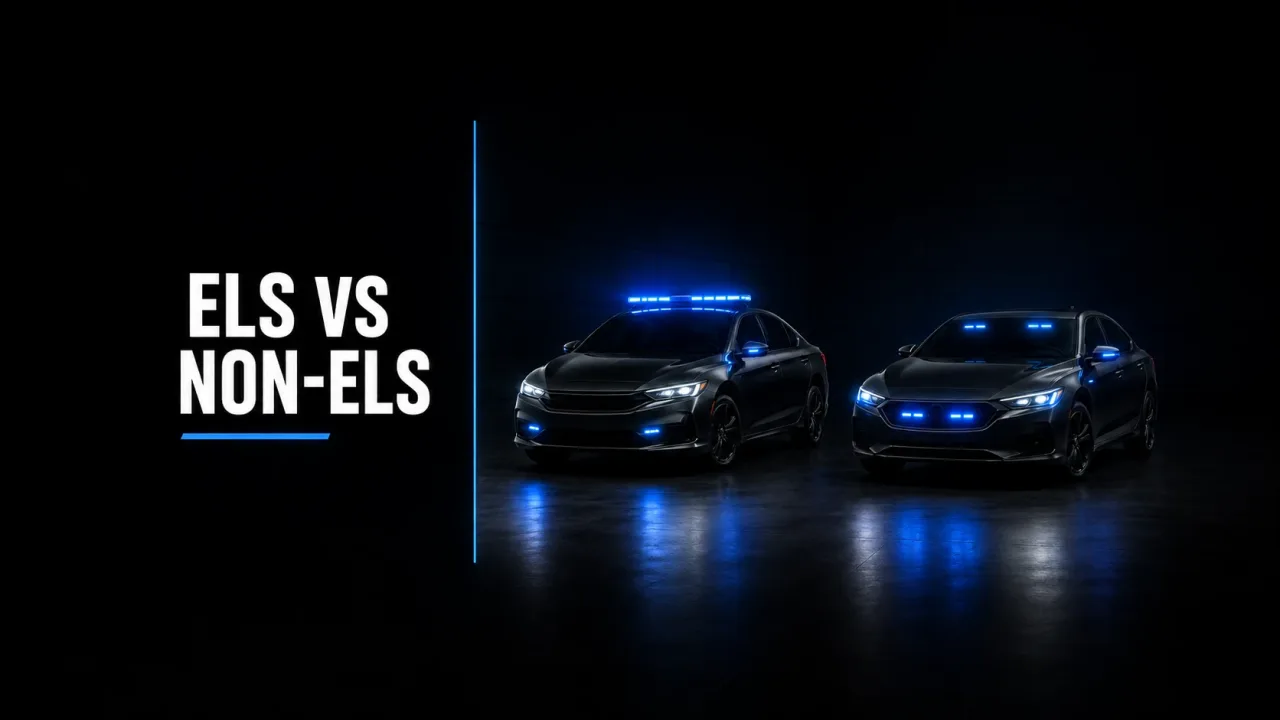
Every police pack you buy in FiveM is built for one of two lighting systems, and choosing the wrong one for your server is how you end up with lightbars that won’t flash, sirens that refuse to sync, and a resmon graph that climbs every time a unit lights up. FiveM ELS (Emergency Lighting System) and the game’s native non-ELS lighting solve the same problem - making a Crown Vic look like it means business - in completely different ways. Get the distinction right once and you’ll stop buying vehicles that don’t fit your setup.
Recommended police vehicles for your server
What ELS actually is (and what it isn’t)
ELS is a standalone resource that takes GTA’s emergency lighting away from the engine and hands it to a script. Instead of the game deciding how your lightbar behaves, an ELS resource reads a per-vehicle XML file - the VCF, or Vehicle Configuration File - and drives every stage from there.
A VCF sits under a single <vcfroot> and breaks into a handful of sections. EOVERRIDE maps your model’s extras (Extra01 through Extra12) and miscs to coloured lights. PATTERN defines the flash sequences - PRIMARY, SECONDARY and REARREDS stages, each a list of <Flash> steps with a Duration in milliseconds and the Extras that fire on that step. SOUNDS handles the horn and up to four siren tones. That per-stage granularity is where ELS earns its reputation: you get the modes the RP crowd asks for by name - warning-lights-only (WL), blackout (BLK) and the staged patterns a driver cycles through with configurable keybinds mid-pursuit.
One myth worth killing: in FiveM you do not manually install ELS on every client. The resource streams to players like any other server resource. What it adds is a client-side script that ticks those patterns and syncs the state across the lobby - and that runtime, not some install step, is the real cost.
How non-ELS lighting works under the hood
Non-ELS isn’t a downgrade. It’s the engine’s own emergency system, the same one Rockstar ships on the vanilla cruiser. The configuration lives in carcols.meta under sirenSettings, where each light is a “siren” tied to an emissive mesh on the model. Rather than switching a bulb on and off, the engine grows and shrinks that emissive to fake the flash, which is why a well-built non-ELS bar can look smoother than a cheap ELS one.
The pattern itself is a 32-bit sequence - literally a string like 11110000111100001111000011110000 - stored in the meta as a single decimal number. The engine walks it left to right at the rate set by sequencerBpm, lighting the emissive on every 1 and killing it on every 0. Rotation for beacons, corona glow and colour are all defined per siren. It’s far less friendly to edit by hand than a VCF, but it costs almost nothing to run because it’s native engine code, not a Lua loop.
The honest trade-offs, side by side
The difference in one line: ELS runs a script that gives you per-stage patterns, custom keybinds and swappable siren tones at the cost of client runtime and network sync; non-ELS uses the engine’s native carcols sirens for fewer manual controls but effectively free performance, zero dependencies and out-of-the-box OneSync syncing. Most modern roleplay servers standardise on non-ELS for exactly that reason.
Siren audio: native tones vs custom banks
On a native vehicle, the siren sound is whatever the model’s audio profile points to, set through audioNameHash in vehicles.meta (POLICE, AMBULANCE, FIRETRUCK and the rest). Swap that hash and you swap the whole profile, siren tones included - blunt, but reliable.
ELS decouples audio from the model entirely. In the VCF SOUNDS block you assign each tone an AudioString, optionally pulling from a shared bank like WMServerSirens through a SoundSet. That’s how a department runs Whelen-style tones on one car and a Federal Q on the next without touching a single game audio file. If custom siren audio per unit is a hard requirement for your RP, that flexibility is the single strongest argument for ELS.
What to check before you buy a police pack
Store pages love the word “optimised” and rarely prove it. Before you check out, confirm four things:
- ELS-ready vs non-ELS build. A pack is one or the other. “ELS-ready” often means the extras are wired but you still supply or generate the VCF; a true non-ELS build ships a finished carcols.meta you can spawn and use immediately.
- Is the VCF included? For ELS vehicles, no VCF means you’re authoring the lighting from scratch. Across a fleet of ten cars that’s a weekend you didn’t budget for.
- Lightbar poly count. Modelled-LED bars can hit tens of thousands of triangles each. Spawn eight units at one scene and a heavy bar tanks frames faster than any script ever will.
- Escrow and edit access. If you’ll need to retune a pattern or fix an emissive, an open-source or unlocked pack saves you; an escrowed one can lock the exact files you need.
When you’re comparing packs across stores, our vehicle pack buying guides go deeper on the spec-sheet red flags, and matching a bar to your city’s identity is a job for custom liveries and lightbar textures.
Converting a pack between the two systems
It’s possible in both directions, but they’re not equal jobs. Non-ELS to ELS means writing a VCF: map each emissive extra to a pattern stage and assign your tones. Tedious, but templated - most ELS resources ship a default VCF you copy and edit.
ELS to non-ELS is the harder trip. You’re rebuilding the lighting inside carcols.meta, defining sirens, coronas and a sequencer value for every stage you want, and often re-linking emissive meshes in the model. Budget real hours for it, and only take it on when standardising a fleet justifies the work. Nine times out of ten it’s cheaper to buy the version you actually need than to convert the one you already own.
The performance cost nobody mentions on the store page
Native sirens barely register on resmon - they’re engine code, so a lit-up non-ELS cruiser costs you essentially nothing. An ELS resource behaves differently: it sits at a low idle and climbs as units activate, because each active vehicle runs pattern logic client-side and pushes state changes over the network.
On a quiet server you’ll never feel it. Stack a multi-car pursuit, a scene full of parked units with bars running, and a busy OneSync population, and the sync traffic plus client tick starts to bite - especially on lower-end player rigs, which is exactly where the “my FPS drops near cops” complaints come from. If you’re already fighting for headroom, our breakdown of FiveM server performance covers where lighting sits in the wider resmon budget.
What to standardise your department fleet on
Pick one system for the whole fleet and commit to it. The most common “our lights are broken” ticket on any server comes from running ELS and non-ELS vehicles side by side - ELS grabs the siren state, and the native cars end up half-working. Consistency beats cleverness here every time.
For most roleplay servers, non-ELS is the better default in 2026: no dependency, native sync, near-zero cost, and it’s now what the majority of quality packs ship as. Reserve ELS for departments that genuinely need per-stage pattern control and custom tones per unit - heavy police-RP communities where a supervisor will notice the traffic-stop pattern is wrong. If you run a serious UK police roleplay division, that control can justify the overhead; for a general city, it rarely does.
The hybrid route - ELS on primary patrol cars players see up close, native lighting on background fire and EMS - works, but only if you respect the rule above: never run both systems on the same physical vehicle, and test siren state on a populated server before you call it done.
FiveM ELS FAQ
Is ELS or non-ELS better for FiveM? For most servers, non-ELS. It’s native, syncs through OneSync, needs no resource and barely touches resmon. Choose ELS only when you need per-stage light patterns, driver keybinds or custom siren tones per vehicle.
Do players have to install ELS themselves? No. In FiveM the ELS resource streams from the server like any other; players install nothing. The cost is the client-side runtime and network sync, not a manual setup on each machine.
Can I mix ELS and non-ELS cars on one server? You can, but keep them on separate vehicles and expect edge cases - ELS takes over siren state, so mixing both systems on a single car breaks the lighting. Standardising the fleet is the safer call.